 Process Automation
From 15 hours a day on HR questions to 2: a case for AI HR Senior
An HR team spent 15 hours a day on ~30 inquiries. With an AI HR agent on an internal knowledge library, the same volume wraps in under 2 hours, in one channel.
A team that re-explained the company to every AI tool now shares one knowledge layer over one MCP connection. Every answer cites its source; review is a click.
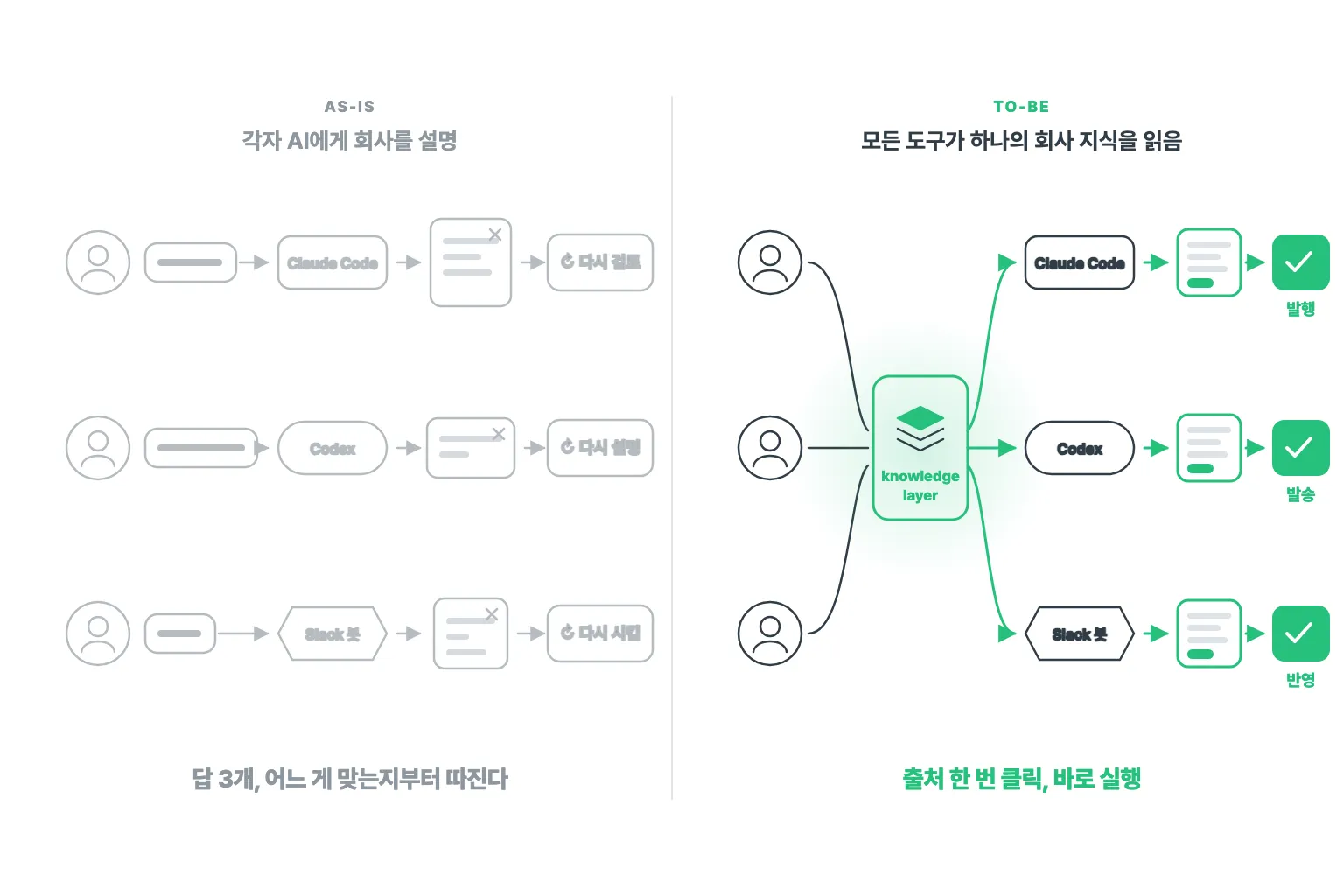
They held the meetings and aligned the guides, and the output still diverged. The team did not want a better AI tool. They wanted every tool they use to understand company knowledge the same way.
The client is a B2B SaaS startup with 10 to 20 people. We had built their CS inquiry-handling logic with them before, so we knew how they worked, and the whole team was fluent with tools like Claude Code and Codex. The tools were not the problem. Starting from the same meeting notes, the company knowledge the AI understood changed with whoever gave the instruction, and so did the direction of the output. Then someone had to re-check which result was right, re-explain to the AI, and run it again. More meetings and more guides did not fix it. The team looked for a way to make every tool they use, including externally integrated agents, read the same company knowledge, and that is why they contacted OTOworks.
“The AI wasn't wrong. The company knowledge it understood was different for every person.”
— Client CEO
We did not change the tools. We laid one layer of company knowledge underneath them and connected it once.
This team did not want another AI tool. They wanted every tool they already used to understand the same company knowledge and work from the same evidence. That is what the knowledge layer is for. We gathered the company knowledge scattered across Notion, Slack, Discord, and internal messengers into a wiki where every entry carries its source, then opened that wiki over MCP so Claude Code, Codex, and the chatbot all read the same place. This client was the first team to adopt OTOntology.
In "RAG is dead, long live RAG", OTOworks traces three years of retrieval-augmented generation being absorbed into the knowledge layer, and the difference between server-side and client-side agentic retrieval.
First we had to name the problem precisely. This was not a team that wrote bad prompts. They had meeting notes and guide documents. But when the person in charge of a report changed, the documents pasted into the AI changed, the sentences explaining the background changed, and in the end the company knowledge the AI understood changed. The same model giving slightly different answers to the same question is simply how generative AI behaves. What we could touch was the step before that: the starting point, which differed from person to person.
We also knew this team was far from alone. Every time we built an internal agent, the starting point was context, and we had been building that up under the name RAG, trying one approach after another. The industry is looking at the same spot. Microsoft calls the layer where multiple agents share one knowledge base and return sourced answers a knowledge layer. Gartner calls it a context layer, Forrester a system of context. There are still more than ten names, but in 2026 they all point to one place: the knowledge layer between tools and data. The only part with a settled standard is how you connect to it, and that is MCP.
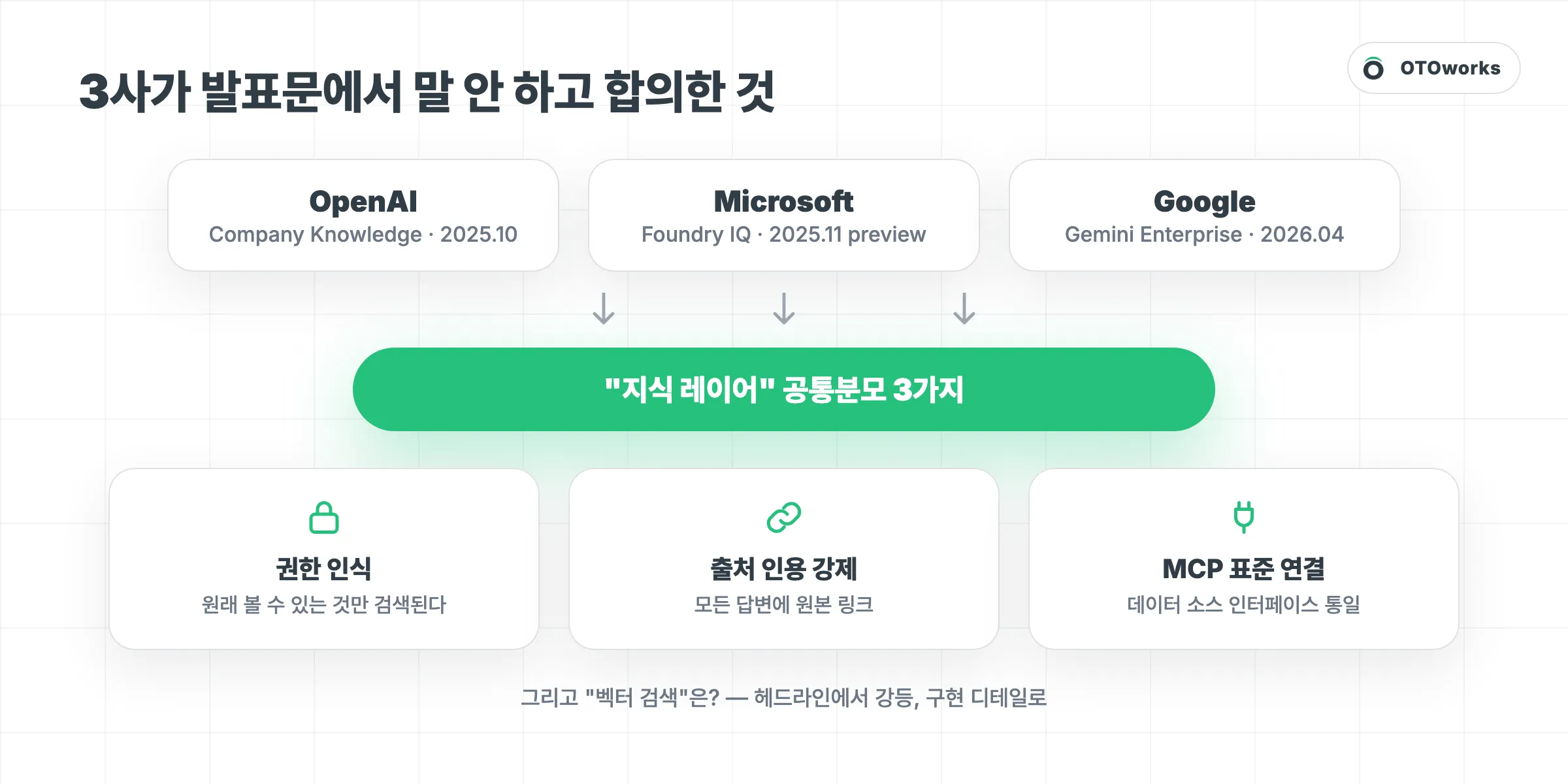
What the three cloud vendors' knowledge layer products have in common. They respect permissions, enforce sources, and connect over MCP.
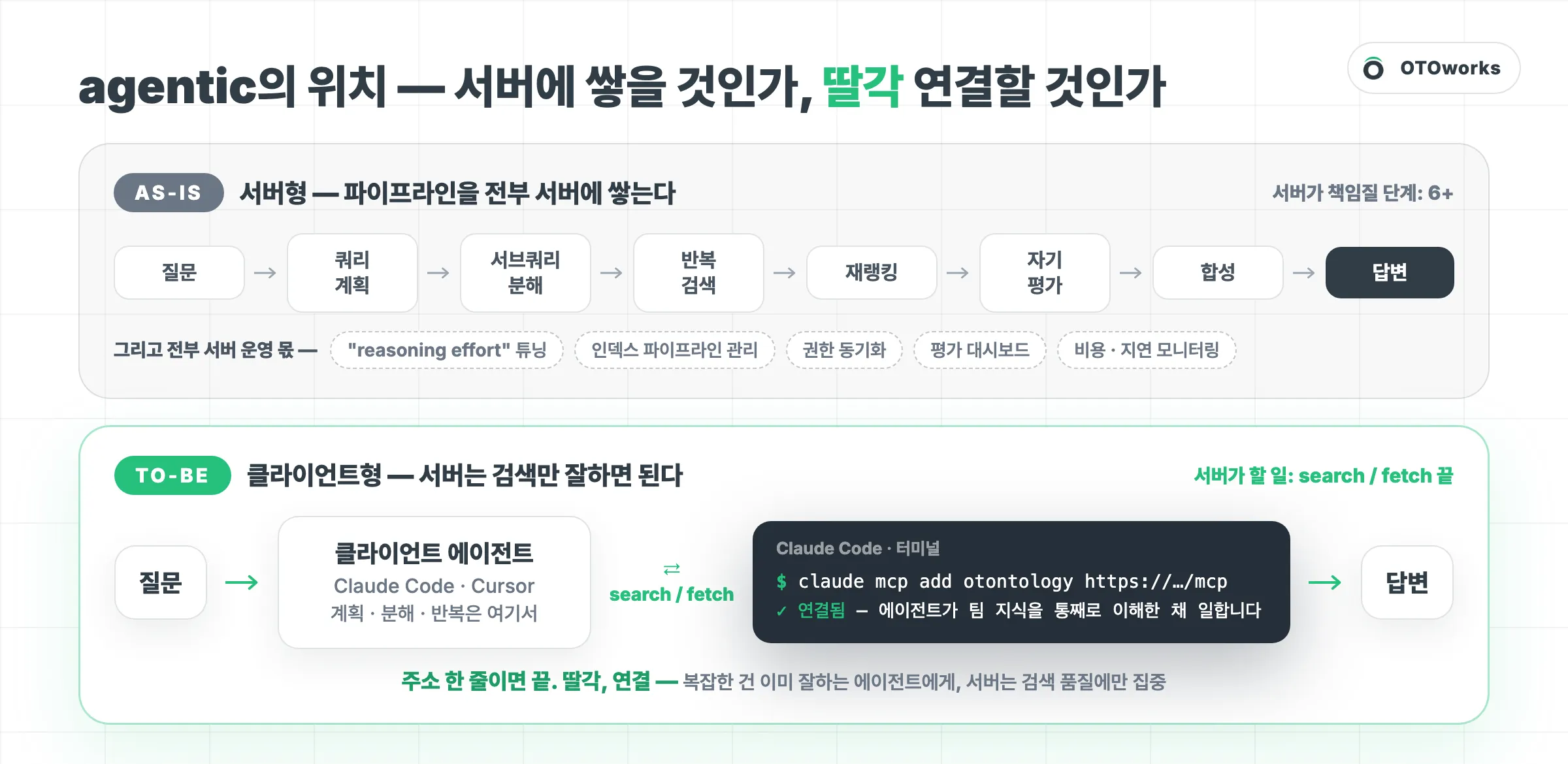
Server-side versus client-side agentic retrieval. OTOntology takes the client-side route: the agent reads knowledge over MCP.
How it connects
There was nothing to install. Connect the internal wikis and messengers, such as Notion, Slack, and Discord, and OTOntology reads the content and builds the wiki. Every entry links back to its original, and changes are re-synced at most every 5 minutes. Then you register the MCP address once. In Claude Code that is a single command; Codex and other tools use the same address. Authentication is per company, and the scope covers the public channels and wiki of the connected workspaces. After that one connection, any tool you ask from reads the same wiki and returns the original links along with its answer.
← Scroll horizontally to view the chart
The connection layout. Company knowledge scattered across Notion, Slack, Discord, internal wikis, and messengers gathers in one layer, and each tool reads from it. Whichever tool you start in, the answer rests on the same evidence.
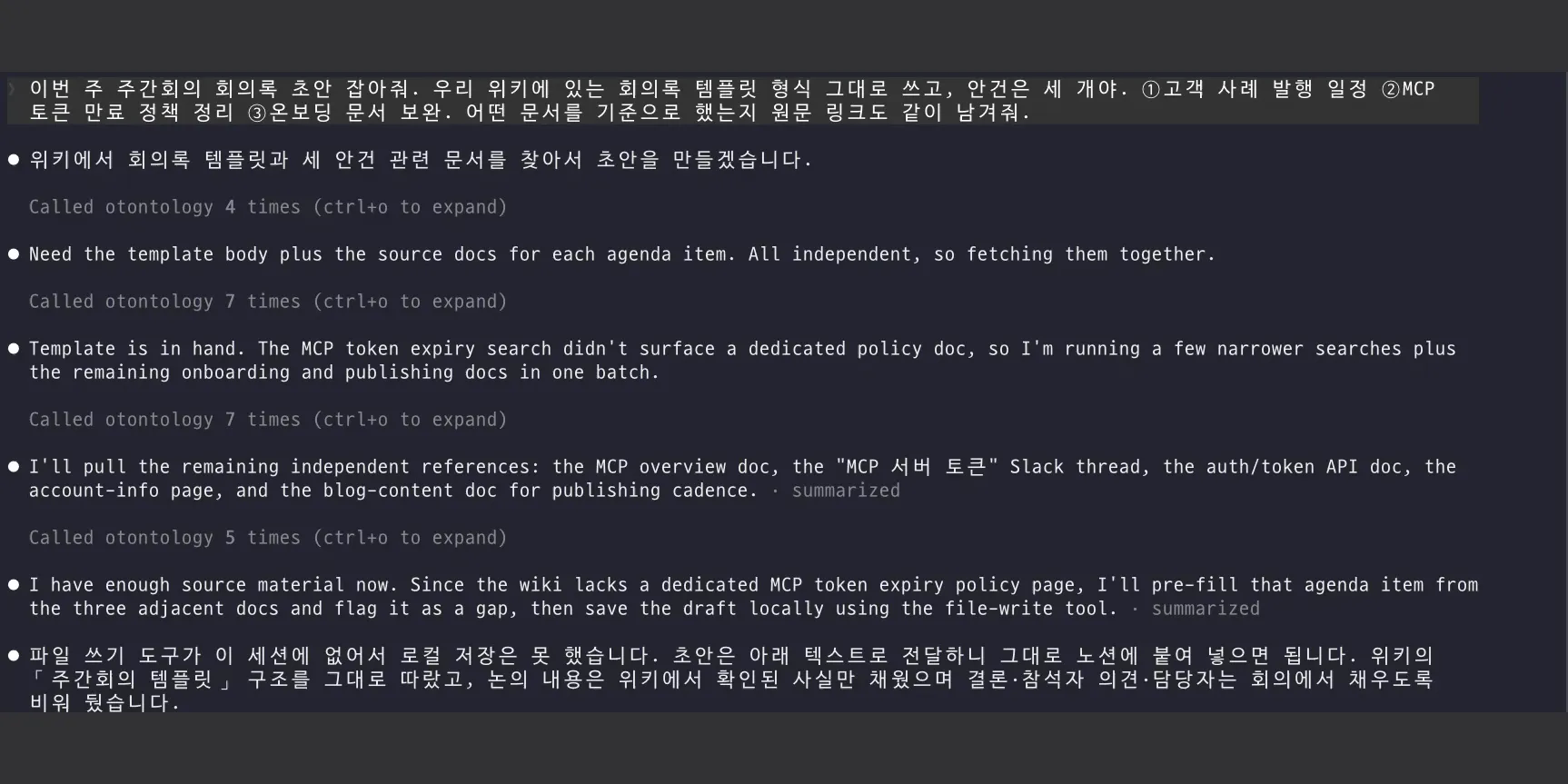
What happens after a one-line request. The agent searches the connected wiki several times and gathers the template and the source documents by itself. Nobody has to find and paste documents.
CX report owner · Claude Code
The first thing to change was the report that started it all. Before, the owner would paste this month's VoC meeting notes into Claude Code, paste the guide document again, and start by explaining the background. That prep differed by person, and so did the result. Now they simply ask for a report from the meeting notes. The agent reads the CI and BI guides, past reports, and the notes on why earlier conclusions were reached, all straight from the wiki. Whoever owns it starts from the same evidence, so the direction no longer swings widely. The wording still varies by person, but the evidence and the direction are one.
CS owner · Slack bot
The CS-handling logic we had built with this team earlier came back to life here. The handling criteria by inquiry type and the response principles existed as documents, but the owner was explaining them to the AI every single time. Now they call the bot in Slack and ask for a draft reply to an inquiry. The bot writes the draft from the handling criteria document and attaches the original link. All the owner has to check is whether the draft follows the criteria, by clicking the link. Response tone drifting from person to person also eased once everyone read the same criteria document.
Developer · Claude Code
The change on the engineering side was quiet but big. Before touching a feature, you need to know why it was designed that way and what issues came up before, and that answer lived somewhere in meeting notes and Notion specs. Before, you asked whoever knew. Now you ask right inside Claude Code. The agent finds the decision records and the original spec in the wiki and lays them out with links, so developers read the whole background before they touch the code. Two things shrank at once: implementation direction diverging by person, and old issues repeated because nobody knew about them.
New hire · Slack bot
New hires end up using a senior colleague as a search box. Where is this procedure? Who do I ask about this? Several times a day. Now they ask the Slack bot first. The bot finds the procedure document in the wiki, answers, and attaches the original link, so the new hire gets the answer and learns where the original lives at the same time. The senior colleague is no longer the person who answers everything, only the person who gets the questions the bot could not find evidence for. And because the bot does not answer without evidence, wrong guidance no longer flows straight to the newest person on the team.
What the team liked most in this case was not speed but sources. Every answer carries the original link. If a search finds no evidence, the model is not called and the bot says it does not know. That changed review. Before, someone had to read AI-written text from start to finish and check whether it was true. Now they click the link and confirm the original, and they are done. Wherever they hand work to an AI, they no longer explain the background and the task. Hunting for documents and asking the next desk dropped just as much.
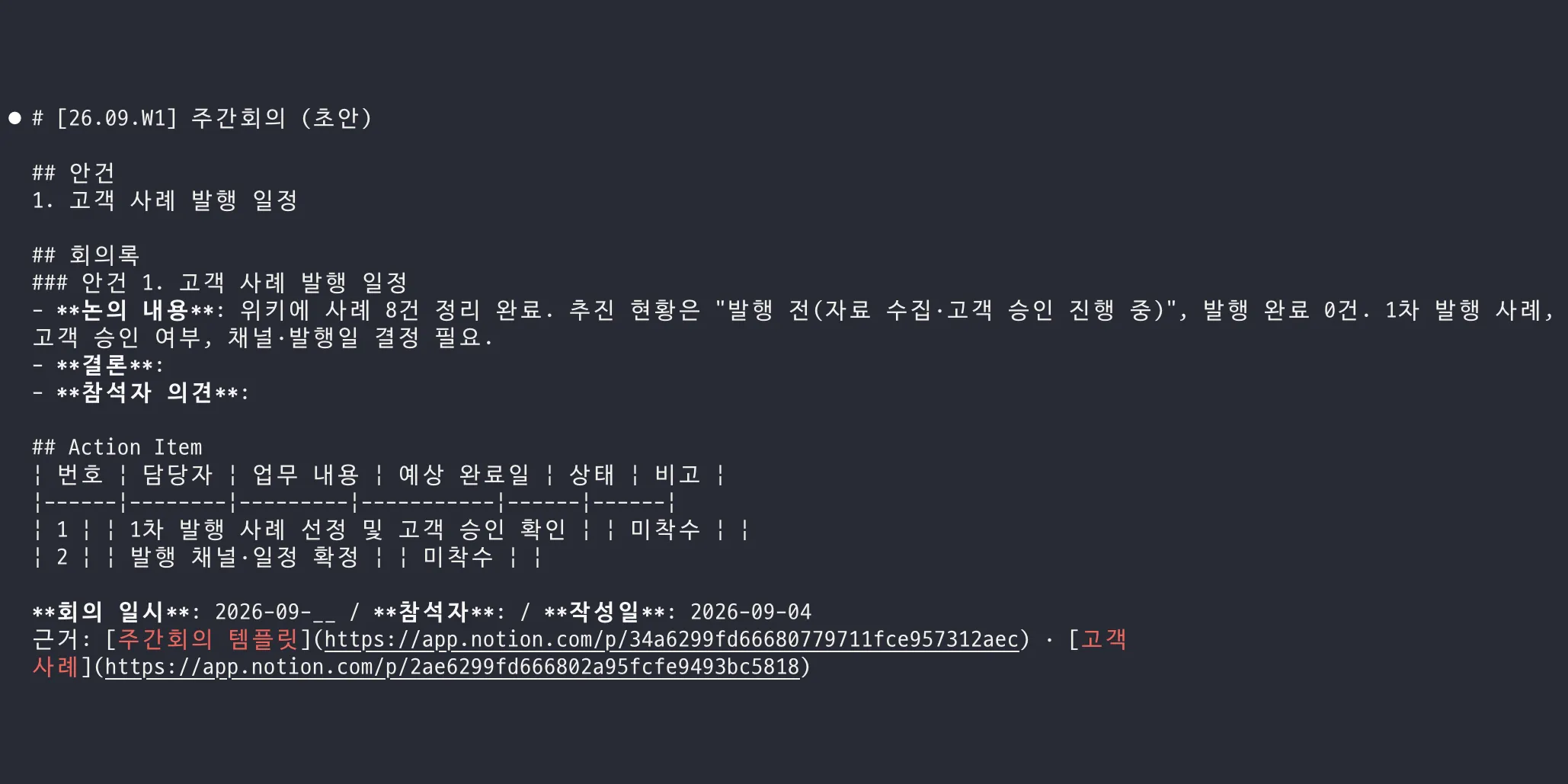
Ask from any tool and the supporting entries and original links sit under the answer. Review ends with a click.
The team's last question was whether the same knowledge could go into agents that integrate with external systems. Because the wiki was already open over MCP, the answer was simple: register the same address. This is also where we learned the clearest lesson of the project. In a team that already uses AI tools well, the place to optimize is not the prompt but the knowledge layer beneath it. OTOntology is what we got by taking the attempts we had stacked up under the name RAG while building internal agents, and trimming them into something light and general that works with a connection instead of an install. This team was its first deployment.
Connect internal wikis and messengers such as Notion, Slack, and Discord, and the content is organized into a wiki with a source on every entry. Nothing to write or maintain by hand; changes are re-synced at most every 5 minutes.
Tools that support MCP, such as Claude Code, Codex, and Cursor, read the same wiki once one address is registered. Authentication is per company, and the scope covers the public channels and wiki of the connected workspaces.
Every answer carries the original link, and if a search finds no evidence, the model is not called. Review ends with clicking the link to see the original.
Call the bot in Slack and it finds evidence in the same wiki. New-hire questions and customer inquiry drafts are handled here.
Variance in results dropped, and review went from reading to clicking.
The biggest change is the starting point. Before, each person handing work to an AI explained the company their own way, and the company knowledge the AI understood differed just as much. Now, whatever the tool, it starts by reading the same wiki. Generative AI still writes a little differently every time, but the evidence and direction shifting from person to person dropped sharply. Because every answer carries its source, review turned from arguing over sentences into clicking a link.
Whoever owns the customer experience report starts by reading the same guides and past decision records. The wording differs, but the evidence and direction are one.
Each answer links to its original, so instead of debating whether it is true, reviewers click through and check. An answer without a source never appears in the first place.
Continue work from Claude Code in Codex, or ask the Slack bot, and it reads the same wiki. The background explanation was done once, at connection time.
The bot takes new-hire questions first and answers with original links. Senior colleagues only get the questions the bot could not find evidence for.
Agents that integrate with external systems read company knowledge once the same MCP address is registered. Before, there was no way to do this.
“I don't explain the background to the AI anymore. Connect it once, and wherever I ask, it answers from the same evidence.”
Client CEOB2B SaaS startup
The problem was never the tools. It was that the company knowledge the AI understood differed by person. The knowledge layer leaves your tools as they are and lays one layer of company knowledge underneath, so whichever tool you ask from reads the same evidence. Connecting takes one MCP address registration.
Every wiki entry keeps its original link, and every answer returns that link. If a search finds no evidence, the model is not called and no answer is given. So an unsourced answer never appears, and review ends with clicking the link to confirm the original.
Yes, register the same MCP address. Authentication is per company, and the read scope covers the public channels and wiki of the connected workspaces. In this case, letting an externally integrated agent read the same wiki was the last request, and a connection solved it with no additional development.
Process AutomationAn HR team spent 15 hours a day on ~30 inquiries. With an AI HR agent on an internal knowledge library, the same volume wraps in under 2 hours, in one channel.
 Process Automation
Half a day per piece down to 30 minutes, revisions from 7 to 1. A small marketing team replaced gut-feel content ops with one ontology-based judgment flow.
 Process Automation
A phone-only solo law practice now takes inquiries 24/7: online intake, auto SMS, and AI draft responses, with zero missed consultations.
If work that starts from the same meeting notes comes out different for every person, it is time to look below the prompt, at the knowledge layer underneath. Keep the tools you use today, and let's talk about how to connect one layer of company knowledge to them.