 Data Collection Automation
In a Market Where Being 3 Seconds Faster Wins
30-50% faster alerts with 0% message loss. Real-time monitoring of 100+ Korean e-commerce sites built for North America's leading cook group community.
12 hours of document sorting cut to 7 minutes with 98% accuracy. AI-powered classification freed an evaluation consulting firm to focus on actual assessments.
A structural bottleneck where expert time is consumed by document classification
This company receives large volumes of business files from external organizations to perform professional evaluation work. The problem was that before any actual evaluation could begin, massive amounts of time were consumed manually classifying and organizing hundreds of pages of documents. Documents arriving in PDFs and ZIP files from multiple sources were completely jumbled together, and just separating them by type and organizing them into the designated folder structure took one specialist an entire day.
“The experts we hired to do evaluation work were spending their entire day just sorting PDF files. As volume increased, overtime increased, and mistakes increased. Document sorting is important, but having people do it continuously just didn't feel right.”
— Client Team Lead
Vision AI-Powered Automatic Document Classification and Folder Structuring System
Simple classification wasn't the goal. We built an end-to-end pipeline where uploading a PDF with hundreds of mixed pages triggers AI analysis of each individual page, document type identification, grouping of consecutive pages into single documents, splitting, and automatic folder structure generation following predetermined rules.
See how the system actually works in action. Watch the entire process from ZIP file upload to AI document classification, folder structure generation, and result download.
Live demo - Complete workflow from ZIP upload to result download
The first thing we had to do was understand how practitioners actually classify documents. We observed the work process directly at their office. Opening a file, flipping through pages, mentally determining 'this is Type A', 'this is Type B', noting page ranges, then splitting the PDF and placing it in folders. Even an experienced practitioner took three to four hours to process a single file with hundreds of pages. We were convinced: 'AI can make these judgments instead.'
The core was Vision AI. We converted each page of the document into an image and sent it to a commercial Vision API to determine what type of document each page belongs to. This isn't simple OCR. It comprehensively analyzes visual features including document layout, table structures, title patterns, and stamp and signature positions to classify. We didn't rely on a single model - we applied a hybrid approach combining rule-based classification with AI classification to maximize accuracy.
← Scroll horizontally to view the chart
AI-based document auto-classification pipeline, from ZIP upload to result download
The grouping algorithm for merging consecutive pages of the same type into a single document was also critical. When the AI identifies pages 1 through 5 as 'Type A' and pages 6 through 12 as 'Type B', it automatically splits them into two independent documents. If the same type runs consecutively but a different type appears in between, it considers context to decide whether to merge or separate. We essentially translated the practitioner's judgment criteria into an algorithm.
Classified documents automatically generate a folder structure according to predetermined rules. Systematic folders are created by source, subject, and reference number, with filenames automatically converted to the 'number_subject_type' format. Simultaneously, a JSON metadata file containing the complete processing results is generated, ready for immediate use in subsequent analysis pipelines. We didn't just organize files - we built a structure that connects to the next workflow stage.
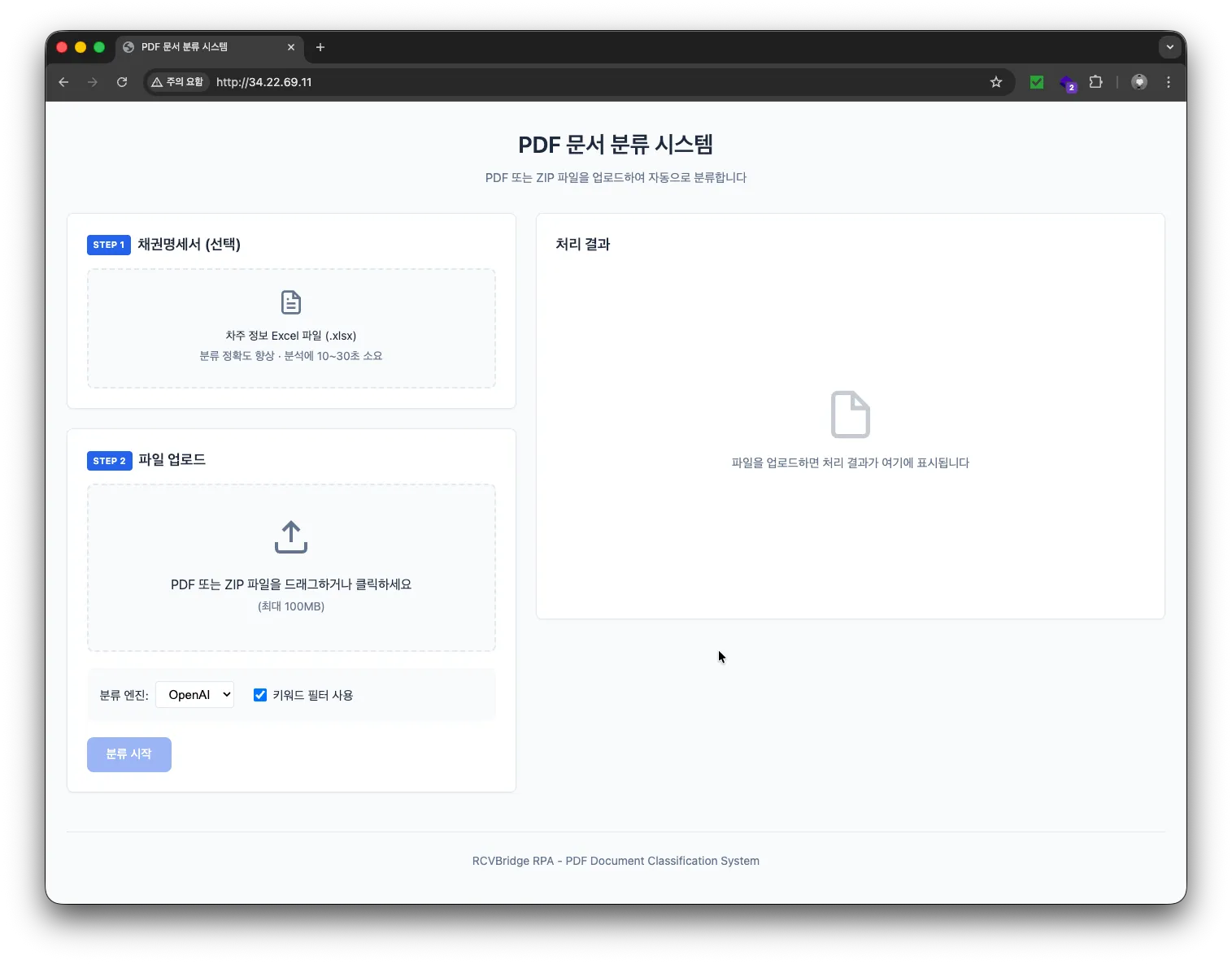
Web-based document auto-classification system - from ZIP upload to result download, all in one place
We made the entire process accessible via the web. A practitioner accesses the web page, uploads a ZIP file, sees real-time progress updates, and downloads the organized results as a ZIP when complete. Since the server processes everything automatically, the practitioner just uploads and goes about other work until the results are ready. What used to take three to four hours is now done with a single upload.
Each page is converted to an image for Vision AI to automatically identify document types. Comprehensive analysis of layout, table structures, and visual features achieves 98% accuracy.
A hybrid approach combining rule-based and AI classification maximizes accuracy. When AI confidence is low, rule-based logic supplements the decision.
Classified documents are automatically organized into a systematic folder structure following predetermined rules. Naming conventions are automatically applied for consistent results.
One ZIP file upload triggers the entire pipeline automatically. Real-time progress monitoring and result ZIP download - all from the web in one go.
Processing results are automatically generated as JSON metadata, providing structured data ready for immediate use in subsequent analysis pipelines.
When new document types are added, just update the classification rules and AI prompts. Flexible expansion without touching the core system.
When the document classification bottleneck disappeared, the entire team transformed
After system deployment, the change practitioners felt was dramatic. The daily routine that started with document classification was replaced by a single upload. PDF files with hundreds of pages are classified and organized in minutes. During that time, practitioners now focus on the professional evaluation work they should actually be doing. Classification errors disappeared, and handoff problems were solved.
Practitioners who spent half their day on document classification now fully concentrate on professional evaluation analysis. The number of evaluations they can process has noticeably increased, and overtime has visibly decreased.
When humans flip through hundreds of pages, mistakes are inevitable - wrong folders, missing files, incorrect classifications. With the system processing everything by consistent criteria, these errors have completely vanished.
Previously, when evaluation volume increased, additional document sorting personnel had to be deployed. Now, even if volume doubles, the system handles it without additional staff. Growth no longer means proportional cost increase.
Previously, document classification criteria existed only in people's heads. When personnel changed, classification standards would differ and training took time. Now the system processes everything by consistent criteria, eliminating handoff burden.
“Honestly, we were skeptical at first whether AI could properly classify our documents. Given our industry, document types are diverse with subtle differences. But OTOworks came in, observed our work, and tuned things one by one. Now? Upload files in the morning, have a coffee, and everything's organized. It's hard to believe we used to do this by hand.”
Client Operations Team LeadProfessional Evaluation Consulting Firm
Data Collection Automation30-50% faster alerts with 0% message loss. Real-time monitoring of 100+ Korean e-commerce sites built for North America's leading cook group community.
 Web Automation
10 hours of daily pricing work reduced to zero. 200+ cosmetics products now auto-updated 24/7 with zero pricing errors across multiple e-commerce platforms.
 Process Automation
How a solo law practice automated consultations: online intake, auto SMS, admin back-office, AI draft responses. Zero missed inquiries, full focus on real cases.
Thinking "Our documents have too many types for automation"? This client thought the same at first. Let's talk - solutions become clear when we discuss together.